

How to Write a Dissertation: A Complete Step-by-Step Guide
In this blog, we will explain how to write a dissertation through a clear, step-by-step outline, ensuring you approach each stage with clarity, confidence, and a strong sense of direction.
It is common for students to look for professional assistance with their dissertations because the process of writing a dissertation can be daunting. It is not an easy task to choose the best methodology, complete a comprehensive literature review, and convincingly communicate your ideas. With the assistance of our experts, your dissertation is sure to be academically sound, well-structured, and convincing, thus increasing your chances of passing with ease and saving you valuable time.
If you are wondering why scholars use our research assistance and PhD assistance services, we discuss this in detail below
Step-by-Step Dissertation Writing Process
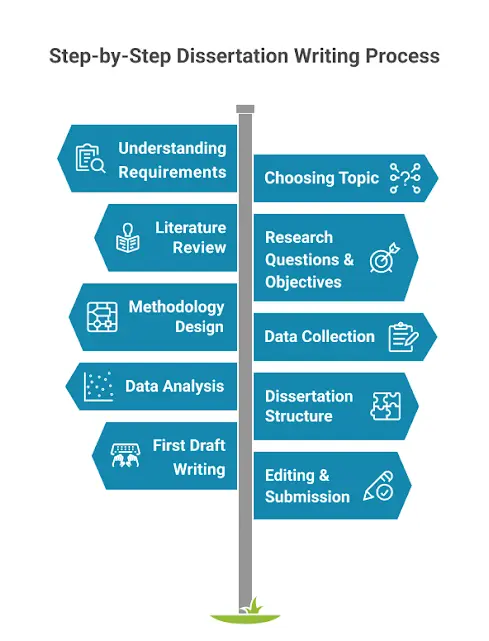
This section presents the entire process of how to write a dissertation in an understandable format, which can be of significant use to scholars in completing their research effectively. Following these steps helps avoid any ambiguity and ensures a smooth, structured approach throughout the dissertation journey.
Step 1: Understanding Requirements
The dissertation writing process starts with understanding university requirements, including format, word count, and citation styles. Knowing how to write a dissertation while complying with these guidelines from the beginning is essential to avoid revisions and ensure a smooth process.
Step 2: Choosing Topic
The topic selection process should include an academically valuable topic that is relevant, well-defined, and researchable. It should neither be too broad nor too narrow, as it would provide an opportunity to make significant contributions to the field of study.
Step 3: Literature Review
The literature review process should be conducted to examine the existing body of knowledge. It would provide an opportunity to establish the theory of the research, which would support the research process.
Step 4: Research Questions & Objectives
Establishing appropriate research questions and objectives is important. Well-structured research questions and objectives help maintain your focus, and your entire research activity will be aligned with the purpose of your study.
Step 5: Methodology Design
Choose a suitable research methodology, whether qualitative, quantitative, or mixed. The methodology of your study should be appropriate for your research objectives, and your entire study should be reliable, valid, and replicable.
Step 6: Data Collection
Collect your data ethically, whether through surveys, interviews, experiments, or secondary sources. Accuracy and ethics are very important for generating reliable results and for the integrity of your study.
Step 7: Data Analysis
Analyze your collected data appropriately, and establish patterns, correlations, and trends. Interpret your results in accordance with your objectives, and provide evidence-based results for your study.
Step 8: Dissertation Structure
Your dissertation structure should include standard sections such as introduction, literature review, methodology, results, discussion, and conclusion. A logical structure enhances readability, guides the reader, and ensures your arguments flow coherently.
Step 9: First Draft Writing
Draft the dissertation in a structured way without worrying about perfection. Focus on presenting ideas clearly and logically, and plan multiple revisions to improve clarity, flow, and overall quality of the work.
Step 10: Editing & Submission
Perform final proofreading, ensure formatting compliance, and conduct plagiarism checks. Prepare your dissertation meticulously for submission, increasing the chances of approval and demonstrating thorough academic diligence.
Why Scholars Prefer Our Academic Assistance
We understand the challenges of dissertation writing, which is why we provide tailored support that helps scholars succeed. Here’s why our services stand out:
-
We provide customized writing tailored to your unique requirements, ensuring every dissertation meets your exact expectations.
-
Our team offers expert guidance from domain specialists at every stage, supporting your academic journey efficiently.
-
We ensure structured academic formatting that fully complies with university standards, creating polished and professional dissertations.
-
Our services include multiple revisions to enhance clarity, strengthen arguments, and improve overall dissertation quality.
-
We provide reviewer-based corrections and refinements to polish your work and meet high academic expectations.
-
Our continuous editing ensures quality enhancement throughout, making your dissertation clear, coherent, and submission-ready.
-
We offer approval and submission support to guarantee timely completion and a stress-free process for scholars.
-
Our fast-track delivery within 100 hours helps you meet urgent deadlines without compromising academic quality.
Tips for Successful Dissertation Completion
For efficient completion of a dissertation, it is not simply enough to possess adequate research skills. One should:
-
Organize well by creating a detailed timeline for each stage of the dissertation process
-
Communicate frequently with your supervisor to align your goals and receive feedback
-
Use your time productively to avoid last-minute rushes and poorly written sections in your dissertation
-
Divide your tasks into smaller sections, such as chapters or sections, to help you focus better
-
Edit your work frequently to improve its clarity, smoothness, and argumentation
-
Use proper citation and referencing to avoid plagiarism in your dissertation
-
Proofread your work thoroughly to ensure grammatical accuracy and compliance with submission requirements.
These strategies improve productivity, reduce errors, and enhance overall dissertation quality.
Conclusion
Learning how to write a dissertation can feel overwhelming, but a systematic approach simplifies the process. By following the step-by-step guide from understanding requirements, choosing a topic, and conducting literature reviews to data analysis, drafting, and final editing, scholars can produce high-quality work efficiently.
A well-executed dissertation not only demonstrates academic competence but also strengthens research skills and critical thinking. It ensures scholarly recognition and contributes meaningfully to your field. Furthermore, professional support can accelerate progress, enhance accuracy, and ensure compliance with academic standards. Ultimately, careful planning, discipline, and structured execution transform the daunting task of how to write a dissertation into a rewarding academic achievement, paving the way for future research or professional opportunities.
Frequently Asked Questions
1. How do I select the right topic for my dissertation?
You can select the right topic for your dissertation by choosing one that is of your interest, with sources available, specific, and academically significant.
2. How much time is required to finish the dissertation?
It takes around several months or one year to finish the dissertation.
3. What is included in the dissertation literature review?
It includes the summary, comparison, and analysis of the literature.
4. How can I write the research methodology section of the dissertation?
You can write the research methodology section by explaining the research design, methods, data collection, and data analysis.
5. Do you offer revision and editing services?
Yes, the services will be helpful in enhancing the quality of the dissertation.