

Literature Review in Research: Professional Guidance for Scholars
A literature review in research is a systematic way of analyzing academic literatures, finding gaps in research, and creating an effective theoretical grounding for your project. We, PhD Helpers support in writing a literature review and advise engineers and research students on their topics and help them get published.
We provide comprehensive support including professional editorial assistance and pub-ready literature review help, specialized expert mentoring, guidance in outline & structure creation, source assessment and thorough feedback to help you get your manuscript published.
What Is a Literature Review in Research?
A literature review is a survey of scholarly sources on a topic. This section can also help you to identify a research problem and to define your scope of work for your paper.
The purpose of writing literature review is intended to build a base of published work that covers the whole subject, to provide the rationale of the work, to improve knowledge in the area, to avoid replication, to locate gaps.
What Are the Different Types of Literature Review?
There are different types of literature review and the one you use will be influenced by your research intentions, your methodology and the coverage of your review. Get our expert guidance and identify the right literature review type.
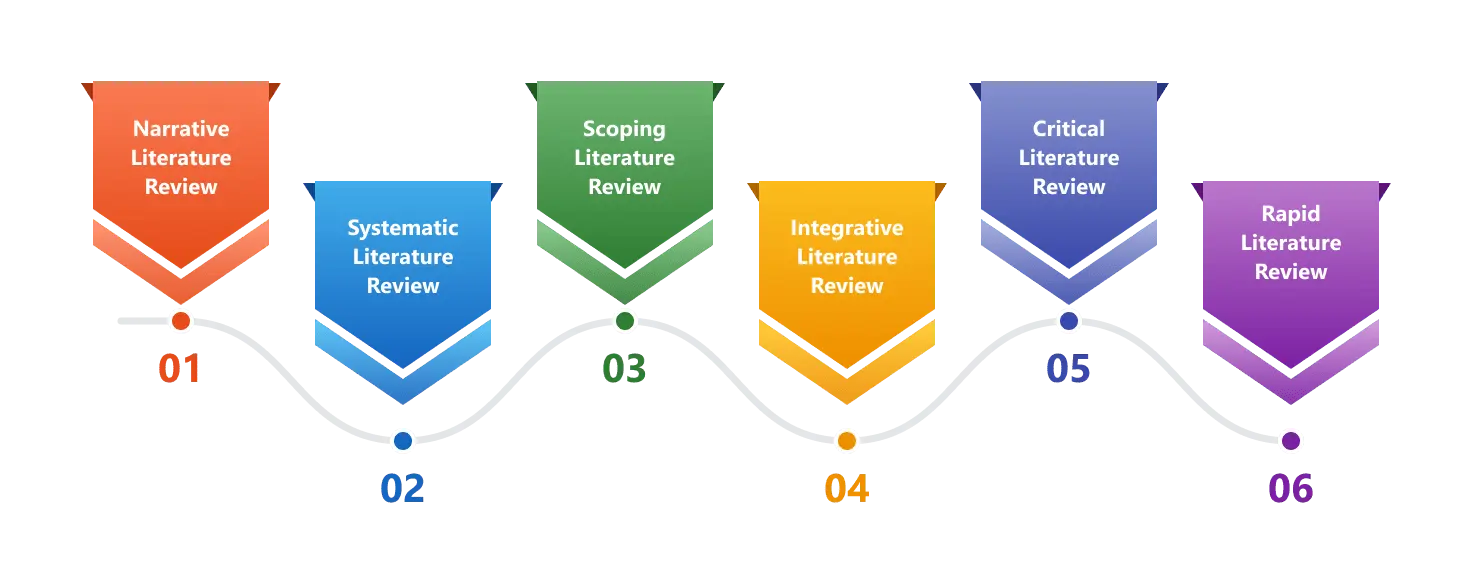
Narrative Literature Review
A broad overview and evaluation of all the available literature in a subject. Helpful when there is a great deal known or to provide context for further research.
Systematic Literature Review
Systematic process with explicit and transparent methods to include and exclude relevant studies. Best applied in evidence based fields when searching for focused answers to limited questions with minimal bias.
Scoping Literature Review
An initial identification of key concepts, types of evidence and gaps in research. Useful when researching novel areas or disambiguating issues prior to a systematic review. First insight into the key concepts, types of evidence and gaps in research. Helpful when exploring new topics or clarifying issues before conducting a systematic review.
Integrative Literature Review
An inclusive approach integrating a range of various methods including experimental and non-experimental. Best for elaborating theories and global models for research questions.
Critical Literature Review
A broad narrative review of the literature, under the guidance of specific theories or hypotheses. The most appropriate for when the review is challenging the orthodoxy, controversial or when a concept is being reconstructed.
Rapid Literature Review
A rapid literature review in research is a simplified review approach that integrates existing knowledge in a limited amount of time. Most suitable for rapidly changing, or busy research environments, or where policy decisions need to be made quickly.
Comparison of Literature Review Types
| Review Type | Primary Purpose | Rigor Level | Typical Use |
|---|---|---|---|
| Narrative | Summarize broad research themes | Moderate | Thesis introduction |
| Systematic | Answer specific research questions | Very High | Medical & STEM reviews |
| Scoping | Map available concepts and evidence | High | Emerging research topics |
| Integrative | Combine theoretical & empirical studies | High | Interdisciplinary fields |
| Critical | Evaluate and challenge findings | Very High | Theoretical papers |
| Rapid | Provide quick actionable insights | Moderate | Policy or urgent projects |
Our expert advice guides scholars in writing a literature review and to decide an appropriate type of review, arrange the appropriate literature, and design a well-organized review depending on the research goal.
Standard Format of a Literature Review
Format of writing literature review is segregated into introduction, a straightforward and easy to understand selection process, theme synthesis, critical analysis, solution to the research gap and references. Our literature review guide will help students how to prepare each part of a literature review correctly and meet their academic and research criteria.
Introduction and Research Scope
Offers a general introduction to subject matter, theoretical framework and scope. Do not make empty generalities or offer opinions that are not related to clearly defined research problems.
Literature Search and Source Selection
Lists the search keywords, database, criteria for inclusion and exclusion. Do not miss stating the inclusion criteria – this lowers replicability of the study.
Thematic Organization and Synthesis of Studies
All groups literature according to themes, concepts, or process. No chronological list of study abstracts.
Critical Analysis and Research Gap Identification
Evaluates strengths and weaknesses of methodology. Remember not to take results of studies at face value without thorough appraisal of methodology.
Conclusion and Future Research Directions
Provides key findings and implications for future research. May maintain a sequence of former literature.
References and Citation Formatting
Lists complete references for all cited works, in the assigned style. Do not alter styles and omit journal reference entries.
Our guidelines guide a scholar to organize its sections, write well, strictly follow guidelines and formatting for all citations and present the work properly.
Our Literature Review Guidance Services
Our subject-specific academic services help research scholars to summarize the literature, filter high-impact journal database sources, and structure the review to make it more engaging and precisely academic.The following are the guidelines for writing a literature review.
Keyword Optimization and Academic Database Searching
We help you identify appropriate target keywords, construct Boolean search strings, and search electronic databases such as IEEE Xplore, Science Direct, Scopus, and Web of Science.
Source Evaluation, Screening, and Selection
We guide sources' selection on peer-review status, impact factors, methodology, relevant publication dates, and predefined screening criteria.
Literature Review Matrix Development and Structuring
We help you in creating appropriate comparison matrices to extract the key information from the research studies, compare the research methodologies, synthesize the empirical findings and identify the key gaps in literature.
Academic Writing Flow and Citation Formatting
We will guide you on how to recognize cohesive paragraph transitions, develop your academic style, and apply the principles of the referencing styles (APA, Harvard, Vancouver, IEEE).
We guide you through every stage of the academic writing literature review process from the initial planning of your first database search to the final organizing of your review of the literature. Contact us today with your subject and research needs.
Why Choose Our Literature Review Guidance Service?
Writing an attractive literature review in research involves an effective process, requiring expertise. With the help of our advice, you will be able to know how to structure your literature review so that it meets the theoretical level, lucidity of your critical, and formal quality.
Subject-Specific Research Guidance
Mentors excel expertise from an academic mentor across engineering, technology and applied sciences to cater to discipline requirements and technical standards.
Critical Analysis and Evidence-Based Synthesis
Goal is to synthesize literature, critique methodology, compare and contrast differing bodies of evidence, and recognize what gaps need to be filled-not to offer only descriptive summaries.
Clear Structure and Academic Consistency
Check for coherence between chapters and sections, correctness of terms and clarity, maintain formal style in the text, and ensure consistency with university standards for writing a thesis.
Support at Every Stage of the Literature Review
Whether you're defining your initial search strategy, assembling a comparison matrix, planning arguments or proofreading your references, we provide structured guidance to accompany you all the way to the finish line.
Get Expert PhD Guidance for a Stronger Literature Review
To craft a literature review to publish, systematic search methods, criticality, and academic readability are generally required. We are here to help you with academic guidance, structural feedback and academic mentoring to achieve your research project targets.