
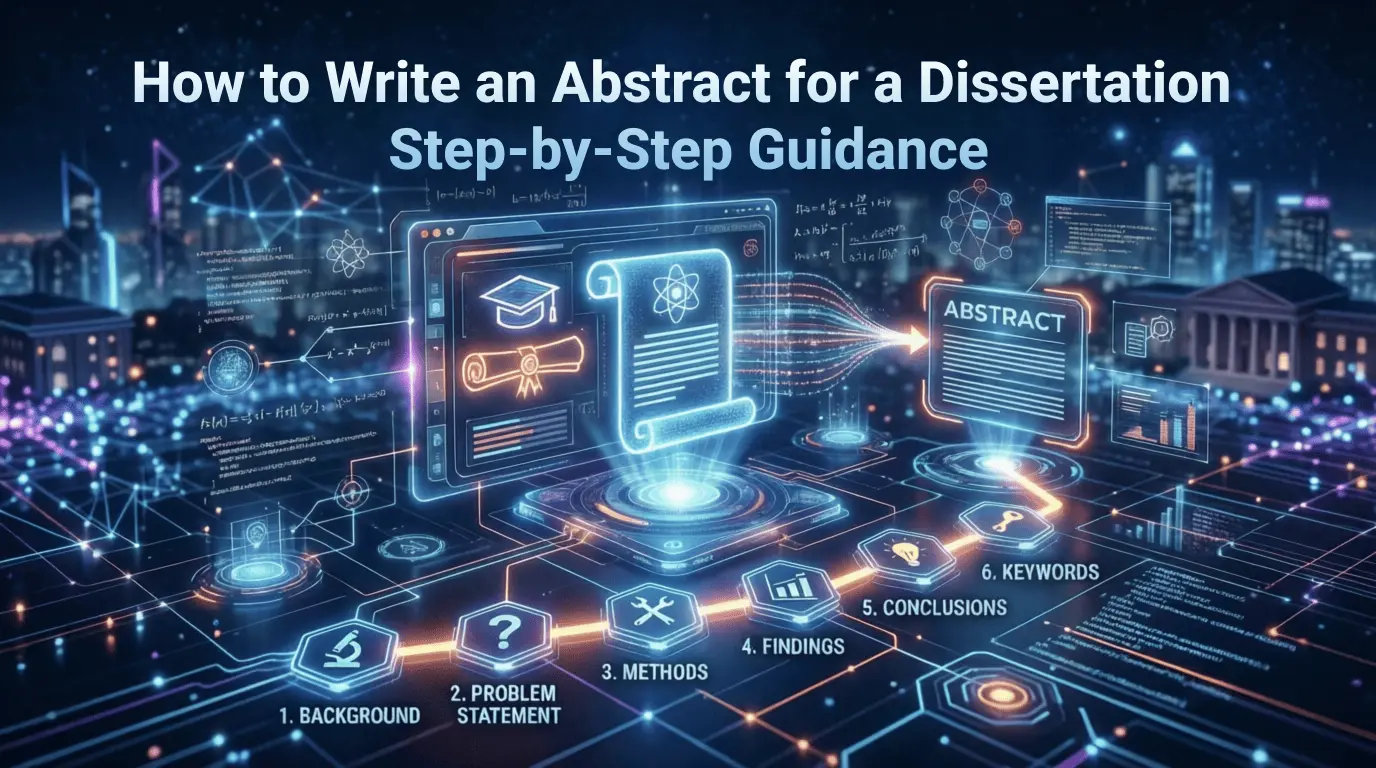

How to Write an Abstract for a Dissertation: Step-by-Step Guidance
Learning how to write an abstract for a dissertation is an important skill for any research student to master. An abstract for a dissertation is like a summary of the entire dissertation, which can help readers understand the purpose, methods, and findings of the study. It is usually the first part of the dissertation that examiners or readers will come across, which makes it extremely important to write it clearly and professionally.
Writing an abstract for a dissertation can also help improve the overall impact of the dissertation. An abstract can be very helpful for researchers to find out if the study has any relevance to their own work. Therefore, it can be said that an abstract can play an important role in improving the impact of a dissertation. In this article, we will see how to write an abstract for a dissertation with the help of step-by-step instructions along with some tips.
What is a Dissertation Abstract?
A dissertation abstract offers a succinct snapshot of your entire research study, letting readers quickly grasp its purpose, methods, and results. Spanning 150–300 words, it boils down the core elements into a clear, professional summary that stands on its own.
Essential Elements
Build your abstract around these five key parts, keeping each to about 20 words for sharp brevity:
-
Research Topic: Introduce the main subject and spell out the specific problem or gap your study tackles.
-
Objectives: Lay out the primary goals, including key research questions or hypotheses that guide the work.
-
Methodology: Sum up the research design, data collection methods, and analysis techniques you used.
-
Key Findings: Spotlight the major results or insights, sticking to outcomes without diving into stats or proofs.
-
Significance: Explain the study's contributions and how it pushes forward knowledge or practice in the field.
Our expert writers provide complete dissertation writing support, helping you save valuable time while ensuring your work meets academic standards and guidelines. With the support of our highly qualified PhD experts, your research will be clear, ethical, scholarly, and impactful.
Step-by-Step Process to Write a Dissertation Abstract
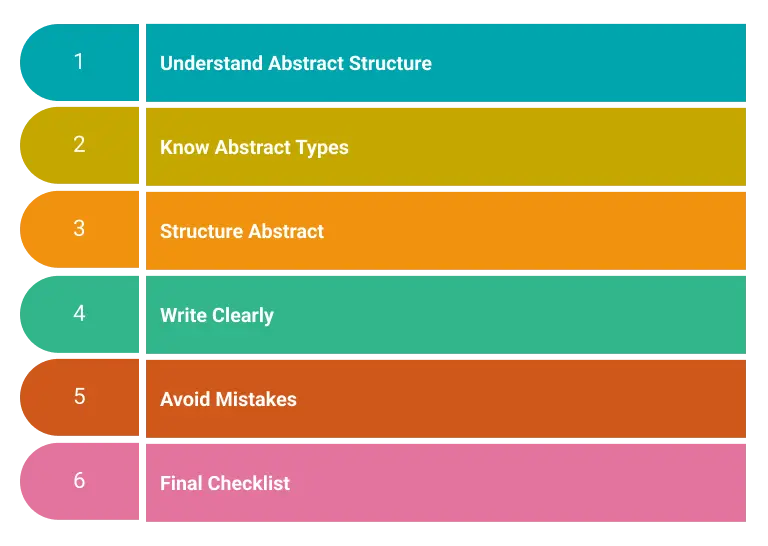
A dissertation abstract is a concise summary that presents the key aspects of a research study, allowing readers to quickly understand its purpose, methodology, and main findings. Writing it effectively requires a clear structure that highlights the most important elements of the research in a brief and focused manner.
Step 1: Understand the Structure of a Dissertation Abstract
Before we begin our writing, it is important that we first understand the basic structure of a dissertation abstract. In dissertation writing, an abstract works as a small snapshot of our entire research, enabling the reader to get an idea about our research, its purpose, and findings within a few lines of text.
Introduction / Background: In this section, we introduce our research topic and explain the major problem or issue our research aims to address.
Objectives / Research Questions: In this section, we clearly explain the purpose of our research and the major questions our research aims to answer.
Methodology: We summarize the research design, data collection methods, and analytical tools used in the study.
Results / Findings: In this section, we highlight the major findings or discoveries our research has made.
Conclusion / Implications: Finally, we explain the importance of our research and how it contributes to the academic field.
Step 2: Know the Types of Abstracts
Before we write an abstract, it helps to understand the different types used in dissertation writing. Choosing the right format ensures our research is summarized in the most suitable way.
-
Descriptive Abstract:
A descriptive abstract briefly explains the purpose, scope, and methodology of the research but does not include detailed results or conclusions. It usually ranges between 100 and 150 words and is commonly used in humanities and theoretical studies. -
Informative Abstract:
An informative abstract provides a complete summary of the research, including objectives, methodology, results, and conclusions. These abstracts typically range from 150 to 300 words and are widely used in scientific and social science research.
Step 3: Structure Your Abstract – Introduction to Conclusion
When we write a dissertation abstract, it should follow a clear structure that reflects the main sections of our research. This helps readers quickly understand the focus, process, and outcomes of the study.
-
Introduction (Purpose & Background):
We begin by explaining the research problem, highlighting the research gap, and stating the study objectives or research questions.
Example: A study might discuss the rapid growth of online learning and identify the lack of research on student engagement in virtual classrooms. -
Methodology:
Here we briefly describe the research design, data collection methods, and analysis tools used in the study.
Example: The research may use surveys and interviews with university students to analyze their learning experiences. -
Key Findings/Results:
We present the main outcomes of the research clearly without including detailed statistics.
Example: The findings may show that interactive learning tools significantly improve student engagement and participation.
Step 4: Tips for Writing a Clear Abstract
When we write an abstract for our dissertation, it is important to be clear and organized. A clear abstract is an effective way to express research ideas.
-
Be Concise: Write the abstract in clear language to describe the research idea, purpose, and results without giving any extra explanation or background information.
-
Maintain Objectivity: Write the abstract in a research-based manner by expressing facts and findings without giving any personal opinion, assumption, or interpretation of the research idea in the abstract.
-
Use Keywords: We should add some keywords related to the academic field so that we can easily locate the topic of the research.
-
Follow the Word Limit: Write the abstract within the required word limit, which is usually 150-300 words, depending on the guidelines of the institution and the requirements of the dissertation submission.
-
Avoid Citations: Do not include references, citations, or external sources since the abstract should summarize the research independently.
-
Revise & Edit: Revise and edit the abstract with proper attention to its clarity, logical arrangement, and grammatical accuracy.
Step 5: Common Mistakes to Avoid
While preparing the abstract for our dissertation, it is important to avoid common mistakes that can affect the quality of the abstract. Sometimes, small mistakes in the abstract can make it confusing or less effective.
-
Including too much background information while not properly highlighting the findings of the research.
-
Writing vague research objectives or questions that do not explain the purpose of the research.
-
Exceeding the word limit while including unnecessary information that affects the conciseness of the abstract.
-
Using complex language or citations that are not required in the abstract.
Step 6: Final Checklist for a Dissertation Abstract
Before finalizing the dissertation, we need to check the abstract to ensure it is effective in summarizing the research. A final checklist helps ensure that all key points are covered.
-
Ensure that the abstract explicitly mentions the research objectives or the research questions.
-
Check if the methodology is summarized and explained in a clear manner.
-
Verify that the research outcomes are clearly identified within the abstract.
-
Check that the abstract explains the importance or contribution of the research.
-
Ensure that the language used is professional and meets the required word limit.
Example of a Well-Written Abstract (120-150 words)
To gain a better understanding of how a dissertation abstract is written properly, it is important to take a look at a good example. A good structure for an abstract will include a brief introduction to the topic, methodology, results, and importance in a limited number of words.
Example:
This study explores the impact of digital learning platforms on student engagement in higher education, addressing the rising demand to understand online learning outcomes. Using a mixed-methods approach, quantitative surveys of 200 students and qualitative interviews with 20 participants, the research reveals that interactive features and timely instructor feedback boost participation and motivation.
The study also highlights Challenges like limited digital access are noted. The findings recommend universities adopt more interactive tools and robust support systems, demonstrating how a well-crafted abstract clearly summarizes research purpose, methods, results, and significance.
Conclusion
Writing an abstract for a dissertation can be made easy by adhering to a structured approach. A well-written abstract should include an introduction to the research problem, the purpose of conducting the research, the methodology, and the findings. Additionally, it should include the contribution of the research to the academic field. By including all the essential information, it becomes easy to write an abstract that is precise and represents the purpose of the dissertation.
In dissertation writing, the abstract is used as an introduction to the value of the research. By ensuring that the information in the abstract is clear, structured, and within the required number of words, it becomes easy to communicate the value of the research to the reader. A well-written abstract does not only make the dissertation readable, but it also makes it impactful by clearly communicating the purpose of the research.
Frequently Asked Questions
1. What is an abstract in a dissertation?
A dissertation abstract is a concise summary highlighting purpose, methodology, findings, and research significance.
2. How long should a dissertation abstract be?
Typically 150–300 words, providing a brief, high-impact snapshot without overwhelming readers.
3. What should be included in a dissertation abstract?
Include purpose, methods, key findings, and significance to showcase your study clearly and professionally.
4. Can you include references in a dissertation abstract?
No, abstracts are standalone summaries and should avoid citations or references entirely.
5. How can I make my dissertation abstract concise and clear?
Focus on essentials, precise language, and value-driven content; master clarity in dissertation writing.