
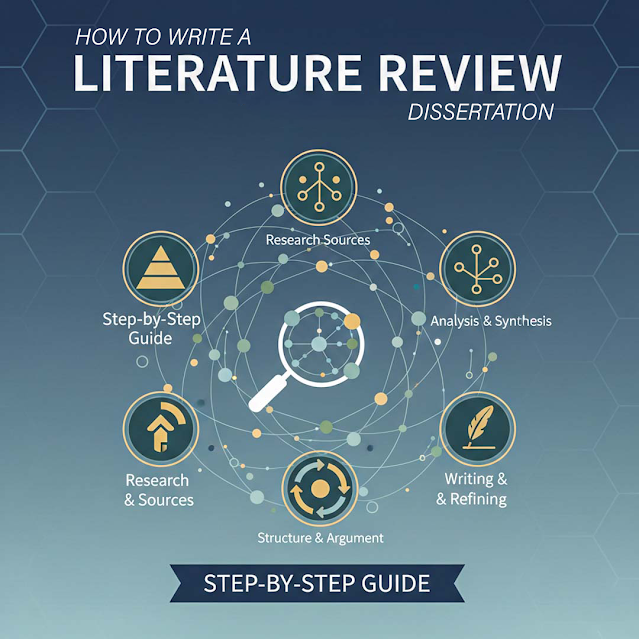

How to Write a Literature Review for a Dissertation: Step-by-Step Guide
It is important to know how to write a literature review for a dissertation, since the literature review is the most important section of a dissertation. Most students wrongly believe that it is merely an overview of the prior research. This misunderstanding often leads to writing a description rather than a critical analysis.
A literature review requires proper planning, systematic research, and critical thinking. It is characterized by a clear scope definition, credible sources, logical organization of findings, and synthesis of ideas.
An effective review goes way beyond what researchers have claimed. It recognizes patterns, analyzes arguments, contrasts methodologies, and points out research gaps that will justify your research. Each phase, starting with the process of choosing the appropriate literature and continuing with the organization of discussions, influences the quality of your dissertation directly.
A properly conducted literature review enhances academic credibility, provides direction for the research, and creates a strong theoretical basis. Use this step-by-step method to make your review high-quality and add to the overall effectiveness of your dissertation.
What is a Literature Review for Dissertation Writing Services?
A literature review is an analytical and formal analysis of the current research as it applies to a dissertation topic. It reviews academic papers, books, theoretical models, and empirical research to establish the main ideas, current discussions, methodological tendencies, and unanswered questions. In contrast to a mere summary, a literature review is a synthesis of information, a comparison of findings, and a critical assessment of the strengths and weaknesses of earlier research.
In dissertation writing services, the literature review is strategic and formative. It makes research logically organized, scholarly, and in accordance with particular research goals. Its main objectives are to establish an academic context, demonstrate a thorough understanding of available literature, outline research gaps, and explain why the study should be conducted in this direction.
The literature review also includes well-developed methodological decisions, as it points out previous studies. It demonstrates critical thinking, intellectual richness, and clearness. Our professionals carefully ensure your literature review is logical, analytical, and scholarly.
Step-by-Step Guide to Writing Your Dissertation Literature Review
.webp)
It is a guide on how to write a dissertation literature review, determining scope, conducting research, planning, analytical reviews, planning writing, and revising to make the text clear and persuasive.
Step 1: Define the Scope
An explicit scope also makes the review pertinent and focused. To determine it, the following questions should be asked.
-
What are the most topical themes or topics?
-
During what period will you be doing your review?
-
What kind of sources are needed: books, journals, reports?
Filter sources with inclusion and exclusion criteria to narrow down on the most relevant research.
Step 2: Search for Relevant Sources
It is essential to be able to find valid sources. Academic search engines, including Google Scholar, Scopus, JSTOR, and PubMed, will be used.
-
Filter results using keywords and Boolean operators such as AND, OR, and NOT.
-
Look for citations and references in major papers to identify other sources.
-
Give preference to peer-reviewed articles and reliable sources.
-
To refer sources correctly, make a clear record of all sources.
A comprehensive search means that you will have the best studies in your review.
Step 3: Organize the Literature
The systematization of the literature provides a clear review. Typical organization strategies would be:
-
Topical: group the sources according to topicality.
-
Chronological: chronologically organize sources.
-
Methodological: cross-examine the research methods.
Patterns and relationships will be identified using concept maps or tables.
Step 4: Analyze and Critically Evaluate
A literature review is not a list, but it challenges your thinking abilities. For each source, consider:
-
Relevance: Does it answer your research question?
-
Credibility: Is the author peer-reviewed and has a good reputation?
-
Methodology: Are the methods valid and reliable?
-
Findings: Do the results make sense or not?
-
Gaps: Does it leave gaps or gaps that are not researched?
Critically analysing your work will improve your professional knowledge and research.
Step 5: Organize Your Literature Review
Organizing your literature review will make it more readable and effective. Typically, a literature review is organized in the following way:
Introduction:
-
Describe the purpose and scope of the literature review.
Body:
-
Organize literature in terms of either theme, chronology, or methodology.
-
Compare and contrast studies.
-
Point out differences, similarities, and new trends.
Summary::
-
Summarize the main points and identify the gaps, relating to your research aims.
-
Use subheadings, transitions, and synthesizing statements to create a flow.
Step 6: Writing Tips
-
Synthesize, and not summarize: Highlight patterns and contrasts, instead of repeating details of the study.
-
Adhere to one of the citation styles -APA, MLA, Chicago, and others.
-
Be scholarly: do not be personal or colloquial.
-
Connect ideas using conjunctions such as; however, similarly, and in contrast.
Step 7: Avoid Common Mistakes
To ensure the quality and credibility of your literature review, it is necessary to avoid common errors.
Pay attention to the following:
-
Do not present just studies without analysis and synthesis.
-
Do not use sources that are out of date or irrelevant, as they will kill your argument.
-
Be logically structured and not a mish-mash discussion.
-
Be consistent in references and style of referencing.
These factors will influence the academic influence of your review.
Step 8: Write the Conclusion
In conclusion, the major insights from the literature should be summarized.
Focus on the following:
-
Overview of significant themes, arguments, and theories.
-
Identify the most notable gaps in the research.
-
Relate the literature results with the research objectives.
-
Give a clear explanation as to why you are studying.
The concluding section supports the structure and the identity of the review.
Step 9: Revise and Proofread
Revision brings in clarity, accuracy, and academic rigor.
During this stage:
-
Check logical flow and coherence between sections.
-
Eradicate duplicity and ambiguity.
-
Incorrect grammatical, stylistic, and citation mistakes.
-
Verify consistency in terminology and formatting.
Critical proofreading is a way of becoming more professional and scholarly.
Final Thoughts
Literature review is the intellectual support of any Dissertation Writing Services. With the help of a systematic methodology - scope definition, finding credible sources, logical organization of research, and critical analysis, students can create a coherent and effective review.
Good literature reviews go beyond knowledge summarization. They explain theories, results, research gaps, and the course of academic investigation. Such analytical depth reinforces all the phases of dissertation research, including methodology and conclusions.
This is a complicated process that is facilitated by professional guidance. Professional help provides clarity, organization, depth of analysis, and accuracy of scholarship, as well as time-saving. For a well-supported, credible dissertation, literature reviews of high quality are necessary.
Frequently Asked Questions
1. What is a literature review in dissertation writing services?
A literature review is an analytical evaluation of existing research relevant to a dissertation topic. It identifies theories, debates, research trends, and knowledge gaps.
2. Are literature reviews customized to each topic?
Yes. Literature reviews are tailored to specific research objectives, disciplines, and thematic requirements to ensure academic relevance.
3. How does a literature review improve a dissertation?
It strengthens the theoretical foundation, demonstrates scholarly understanding, and justifies research direction and methodology.
4. How are research gaps identified in the review?
Research gaps emerge through critical comparison of studies, highlighting limitations, contradictions, or unexplored areas.
5. How is credibility ensured in the literature review?
Credibility is maintained by using peer-reviewed sources, reputable journals, scholarly books, and systematic evaluation.
6. Are literature reviews adapted to all disciplines?
Yes. While structural principles remain consistent, reviews are tailored to discipline-specific theories and research conventions.