
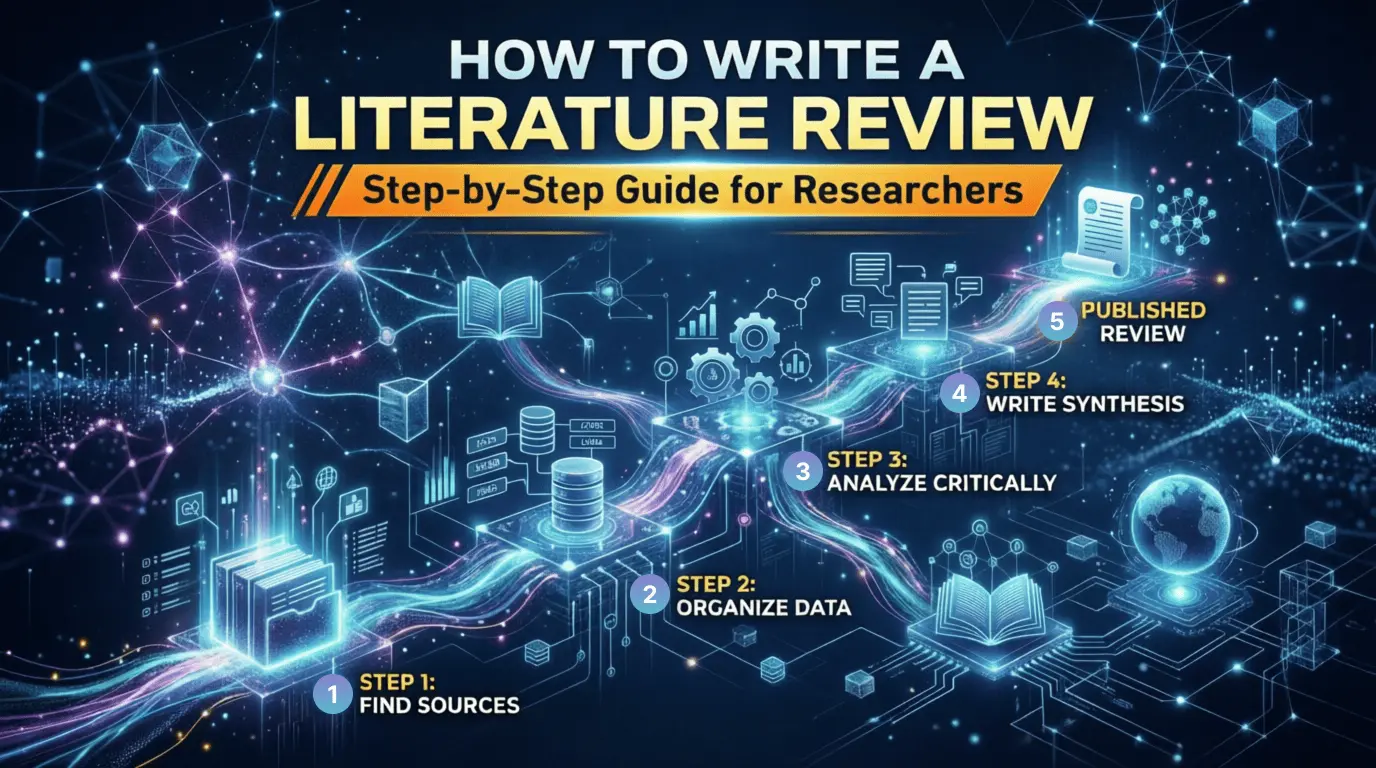

How to Write a Literature Review: Step-by-Step Guide for Researchers
Understanding how to write a literature review is an essential skill for researchers who want to create a strong academic foundation. A well-prepared literature review helps identify gaps in existing research, avoid duplication, and establish a structured basis for your study. It allows scholars to critically engage with prior work, highlight trends, and strengthen the credibility and impact of their research.
As for this guide, we will cover everything related to writing a literature review. The process consists of several key elements, including setting the research scope, conducting a literature search, selecting relevant studies, organizing sources, critically reviewing the material, synthesizing and analyzing findings, and structuring the literature review effectively.
The guide will also touch upon some guidelines in writing that may help one write an even better paper. We will also provide useful advice for writing that can increase your chances of success. Finally, we'll conclude on the significance of having a well-written literature review.
What is a Literature Review?
A literature review is an organized analysis of scholarly material aimed at making researchers comprehend the current status of affairs in the subject area. A review serves as a great source of academic background in the discipline under investigation. Knowing how to write a literature review enhances its effectiveness and clarity.
The completion of a literature review helps the researcher fill possible research gaps, prevent duplication, and build the foundation for his or her study. A literature review is a great way to ensure the reliability of research findings and serve as the basis for the methodology and research questions.
Main features of a literature review:
-
Systematic analysis of academic materials such as journals, books, dissertations.
-
Comparative analysis of various studies.
-
Identifying research gaps and open issues.
-
Building theoretical grounds and researching methodology.
Step-by-Step Process to Write a Literature Review
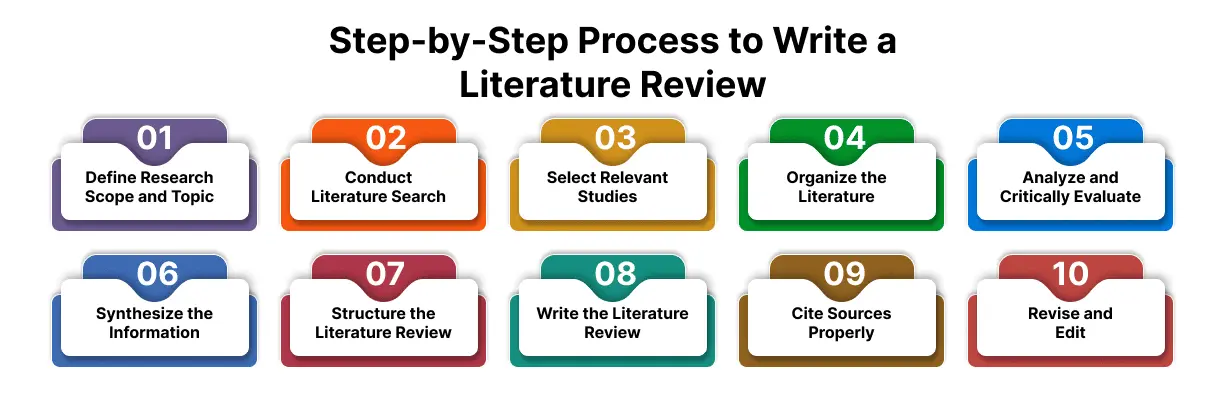
Understanding what is literature review is essential, as it must be written systematically.The following points help make your review coherent logical and credible for effective research helping you structure your sources connect ideas and present your findings in a clear logical way
Step 1 – Define Research Scope and Topic
To begin with, select a specific topic for conducting research that will be useful for the purpose of the research. Clearly define the scope and boundaries of research, including time span and subject area.
Step 2 – Conduct Literature Search
Make use of various databases such as Google Scholar, Scopus, Web of Science, and IEEE Xplore to find literature relevant to the topic. Use key terms and synonyms to gather useful sources of information.
Step 3 – Select Relevant Studies
Apply inclusion and exclusion criteria, focus on high-quality journals and recent studies, and remove irrelevant or duplicate research to ensure your literature review example is accurate, focused, and fully aligned with objectives.
Step 4 – Organizing Literature
It is advisable to use tools such as Zotero, Mendeley, and EndNote. Categorizing literature according to themes, methodologies, timelines among others will ensure that one has organized summaries that are easier for analysis, synthesis, and writing.
Step 5 – Analyzing and Evaluating Critically
The selected studies are to be compared and contrasted to highlight their similarities and differences. This stage ensures that there is a critical evaluation of the sources used to generate insightful information.
Step 6 – Synthesizing Information
Synthesis refers to combining insights derived from different pieces of literature. The process involves drawing connections between the different studies. Therefore, it entails finding commonalities and connections rather than summarizing papers.
Step 7 – Structuring the Literature Review
Using a structure that is chronological, thematic or theoretical can improve the flow and organization of your literature review, while also assisting with communicating your ideas to the reader. When organizing literature, selecting an appropriate structure is important to the literature review.
Step 8 – Writing the Literature Review
Writing the literature review entails giving an introduction, having discussions among the group members for analysis and giving citations for the sources used. The transitions should receive careful consideration to ensure that you have maintained coherence in your writing.
Step 9 – Cite Sources Properly
Ensure that citations of the sources are done in a consistent format, such as APA, MLA, or IEEE. This is necessary to avoid plagiarism, maintain accurate citations, and give the necessary references to support your assertions in your literature review.
Step 10 – Revise and Edit
Examine your work for clarity, logical flow, grammar, and formatting. Edit to eliminate redundancies, enhance readability, and correct all typographical errors to make your literature review a polished, professional, academically-based product.
Tips for an Effective Literature Review
Understanding how to write a literature review effectively can save time and improve the quality of your research. Following these simple strategies helps create a clear, organized, and meaningful review.
-
Gather material in advance and analyze literature to avoid any omissions.
-
Do not choose materials or subjects that have nothing to do with your research objectives.
-
Analyze information critically and focus on what is missing, contradictory, and strong.
-
Organize your thoughts so that the structure of your paper is clear.
-
Keep accurate notes and a bibliography for easier citations in the future.
Conclusion
Literature review is crucial in building an effective academic background as well as in doing research. Knowledge on how to write a literature review enables you to discover gaps that need more attention, to avoid repetition in research, and to build a basis for your study's credibility.. Understanding what is literature review helps clarify its purpose, scope, and importance in guiding your research effectively.
Through this guide, you can learn about the procedures in doing literature review; such as selecting a topic, conducting a literature search, selecting studies, organizing studies, critically analyzing findings, synthesizing data, structuring the paper, citing references, and revising the paper among other things.
Frequently Asked Questions
1. What is the main purpose of a literature review?
We examine past research, find research gaps, and demonstrate how our study adds value.
2. What sources are used in a literature review?
Our sources include periodicals, books, conference proceedings, dissertations, and reputable institutional or governmental publications.
3. How do we organize a literature review?
We arrange our review according to themes, chronologically, and methods.
4. Why is citation important in a literature review?
Citation enables us to acknowledge others' contributions, avoid plagiarism, gain credibility, and enable verification.
5. How do we begin a literature review?
The process involves defining our subject, searching for sources, reading, note-taking, and discerning trends.