
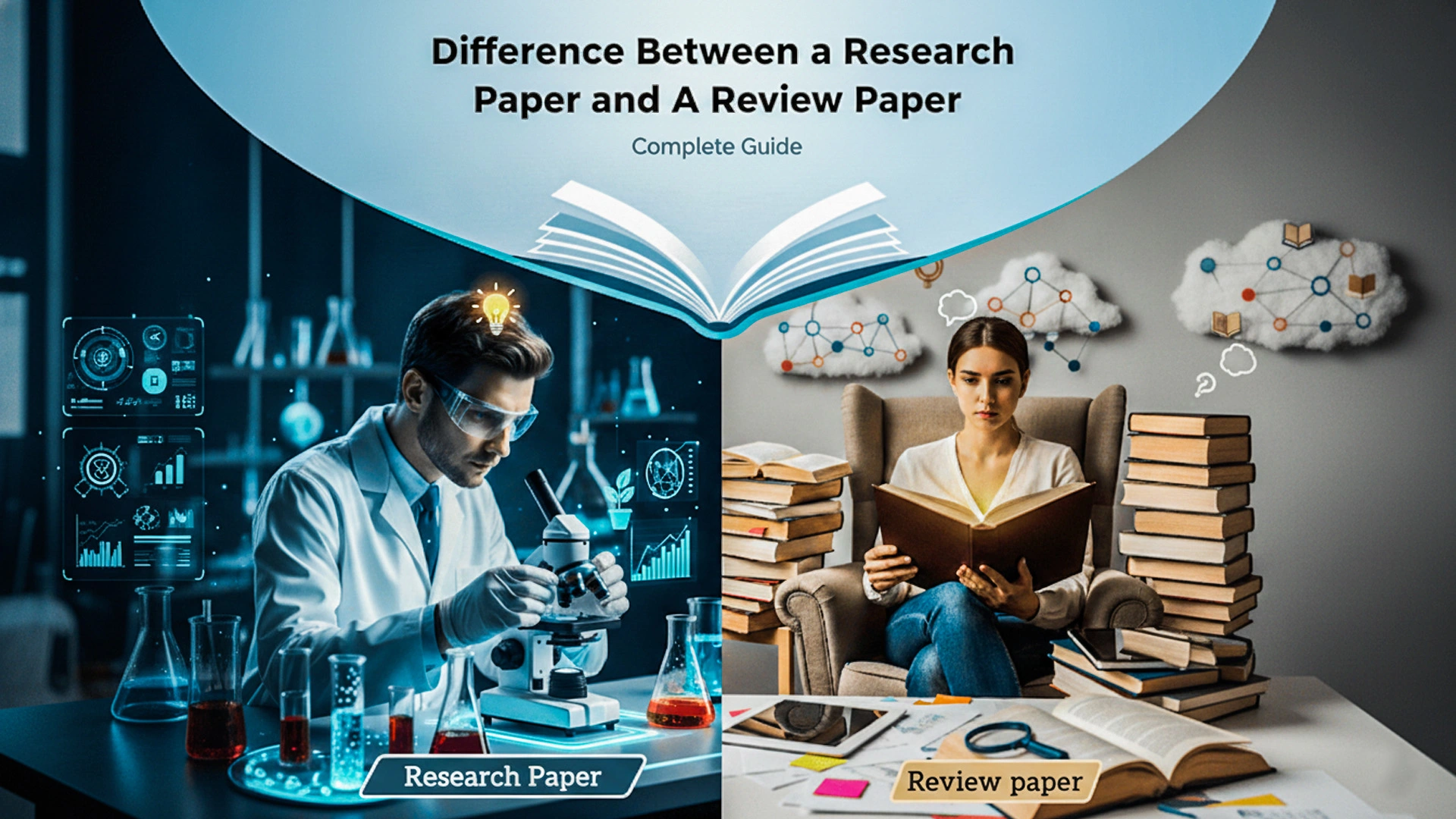

Difference Between a Research Paper and a Review Paper – Complete Guide
Academic publishing is a field in which every researcher should be familiar with various writing formats that exist. Learners and early-career researchers are facing the most basic issue when it comes to the difference between a review paper and a research paper. Both are essential scientific documents, but they play immensely different purposes in the scientific community. One introduces new concepts; the other studies already available ones.
There can be insurmountable obstacles when trying to confuse these formats in submitting a thesis or a high-impact journal. Knowing their differences is of great importance to the success of your academic projects. This guide will be about definitions, structural requirements, purpose, and tips about the work that make you a professional. Calm down, we have the professional staff that will assist you in the writing process to be clear and excellent.
What is a Research Paper?
A research paper is an official document that reports initial findings by conducting a systematic study of a certain hypothesis. The writing of the research paper is always based on primary research. Authors gather their own data, make a serious analysis, and reach conclusions that are not published in other places. These articles are the main means of publication in scholarly journals since they give the bare evidence that is required to make a field develop.
To use the example, a researcher may examine the effect of AI on student performance by surveying universities and resorting to complex statistics to identify correlations. A clear experimental design and ethical approval are needed in this study. In case of problems with the interpretation and formatting of data, our research paper writing professionals will show you how it can be done.
What is a Review Paper?
The review paper summarizes and synthesizes existing research without any new experimental data. It follows a secondary research strategy, wherein attention is given to the literature published by other researchers. This is aimed at detecting trends, emphasizing contradictory results, and locating gaps in the body of knowledge. This helps the academic community gain a comprehensive overview of a topic without having to examine hundreds of individual studies.
A good example is a detailed article on renewable energy, including a comparison of solar and wind power efficiency based on 10 years of data. This paper can be invaluable in keeping abreast in a wide area. No worries, we are here to help with your review paper; it is critical, well-structured, and ready for a prestigious academic journal.
Review Paper vs Research Paper: Key Differences
The key differences between a review paper and a research paper are the way information is presented through them and their contribution to science. The following table compares the most important contrasts and selects the most appropriate format to use in your publication, project, or even academic work.
|
Feature |
Review Paper |
Research Paper |
|
Primary Goal |
Summarize and synthesize existing studies. |
Present original data and findings. |
|
Data Source |
Secondary (existing literature/published papers). |
Primary (experiments, surveys, trials). |
|
Methodology |
Systematic search and selection criteria. |
Detailed experimental or study design. |
|
Structure |
Thematic headings and critical analysis. |
IMRaD (Intro, Methods, Results, Discussion). |
|
Contribution |
Consolidates and identifies research gaps. |
Expands boundaries with new knowledge. |
Why Knowing the Difference Matters
It is not just academic to know whether you are writing a research paper or a review. It determines what you write about and when you write. The data collection of original research can take years, whereas a review can require months of dedicated reading. Knowing which one you are writing improves your submission success rate and enhances the overall professional quality of your portfolio.
Misclassification can lead to rejection by editorial boards, as reviewers have other standards. In the case of a research paper, editors ensure the validity of the experiment; in a review, they put a premium on an extensive bibliography. Good identification ensures that the project is running on schedule and avoids the expensive structural revisions.
Step‑by‑Step Process to Write a Research Paper
.webp)
Composing a paper will require discipline, a plan, and high standards to ensure the findings are reliable. It transforms a mere observation into a recorded discovery using various major steps.
-
Identifying a Topic: Choose a narrow subject that leaves a certain gap in the existing literature in science.
-
Literature Review: Research well to ensure that no one has already carried out the study you intend to do.
-
Defining Objectives: State your research questions or your hypothesis to be tested.
-
Develop Methodology: Develop a replication of your tools, participants, and procedures.
-
Gathering Data: Conduct the study, gather raw information, and maintain high ethical and organizational standards.
-
Results Analysis: Statistically or qualitatively analyze the data and identify patterns that are of significance.
-
Writing Manuscript: Type up the IMRaD parts and ensure your discussion is connected to the initial hypothesis.
-
Editing and Submission: Revise and proofread the language, check that you have used references, and make your submission as you find suitable for a journal of your level of interest.
Step‑by‑Step Process to Write a Review Paper
.webp)
The process of writing a review paper involves analytical and critical thinking, not a manual activity. It requires a plan to filter through so much data and create a clear, publishable story.
-
Choose a Subject: Choose an existing or hot topic that requires a summary of the recent research.
-
Systematic search: Find all the relevant papers on the topic using databases like PubMed or Scopus
-
Screen Studies: Narrow Search Results by Quality and relevance to the scope of your review.
-
Find Themes: Prepare to select papers that meet your discussion in a small number of core themes or categories.
-
Study Trends: Identify general conclusions and significant inconsistencies between authors in the field.
-
Draft Sections: Prepare an introduction, the thematic body paragraphs, and the research gaps segment.
-
Refine Content: The synthesis should be critical, not merely a list of summaries, to have complete coverage.
Common Mistakes to Avoid
Researchers are likely to fall into pitfalls that compromise the integrity of research and review papers. The first mistake is not conducting a thorough literature review, which may result in duplication of work or a lack of a research question. Methodology is weak in numerous studies, and review articles are subject to cherry-picking, picking up the research studies that confirm a bias rather than address the field in a completely objective manner.
Citations and irrelevant content can cause one to be rejected. With reference-management software like Zotero or EndNote, and with the help of professional editors, your manuscript is scrutinized and polished, and your citations are done correctly, so that your work should meet the high-quality standards of publication in academic journals. Avoiding long-winded content and using a logical structure of the material helps the reader not to lose interest in reading, or basically to omit your primary scientific input.
How These Papers Are Evaluated
The standards of research and review papers are based on the quality of thought and performance. In the case of a research paper, the reviewers seek originality, a strong methodology, and correct results. They also confirm compliance with ethics and determine the progress of the findings towards the field. To pass peer review, clear writing and evidence are required.
In the case of a review paper, one is concerned with completeness and proper synthesis. The evaluators would like to find that the author identifies the gaps that matter and would provide a new insight rather than duplicating others. It is vital to have insight and well-structured themes. Good citations and minimal wording increase academic and search-engine presence.
Conclusion
The distinction between a research paper and a review paper lies in their aim. A research paper is new knowledge and depends on primary experiments, but a review paper is a clarification of existing knowledge. Learning the two will make you more credible and publishable. Employing definite strategies, rational organization, and professional skills helps you write academic papers that contribute to your area of study and the scientific world.
Navigating these differences can be complex, but you don't have to do it alone. Find advice and materials from our expert team. We assist in streamlining ideas and manuscripts as well as achieving publication objectives through smooth and professional methods. Whether you are initiating an original study or trying to create a review of the literature as a whole, our team will help you achieve success.
Frequently Asked Questions
-
How does a research paper differ from a review paper?
A research paper presents original data from your own experiments, while a review paper analyzes and summarizes data that other people have already published.
-
Can a paper be both a research and a review?
Journals categorize them separately. However, a research paper always contains a small literature review section, and some "systematic reviews" use statistical methods that feel like new research.
-
Which paper type is better for beginners?
Beginners may well start with review papers. They allow you to research a subject using the available literature and then spend time and money on experiments.
-
Are research papers more valued than review papers?
Both are highly valued. Research papers prove you can discover new things, but review papers often get more citations because other scientists use them as a "one-stop shop" for information.
-
Can a student publish a review paper?
Yes, students can publish reviews. It is an excellent way to demonstrate deep subject knowledge and build a publication record early in an academic career.