
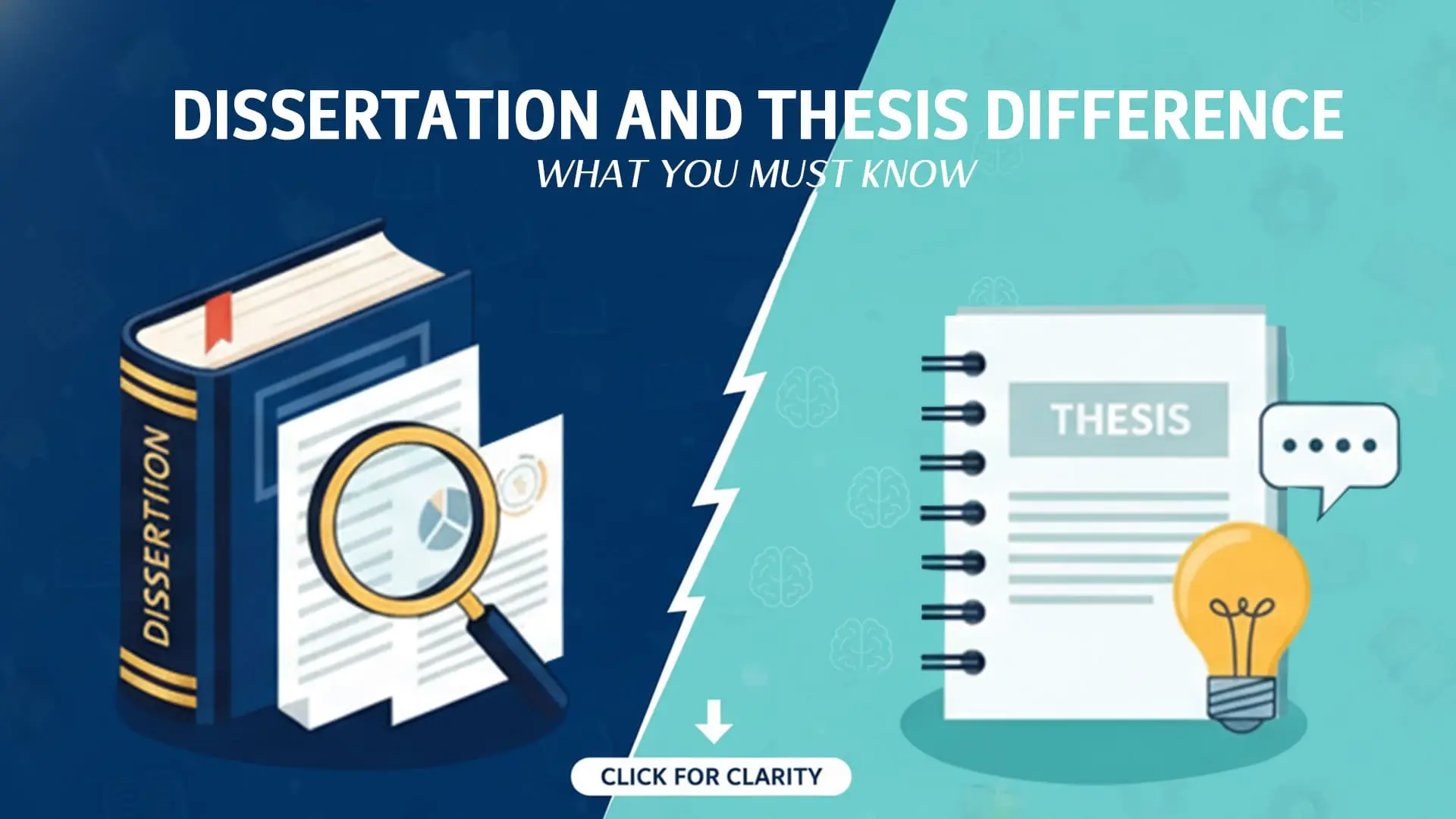

Dissertation and Thesis Difference: What You Must Know
Many students struggle to understand the dissertation and thesis, often assuming that both terms refer to the same type of academic research project. This confusion is especially common among first-time graduate students who are navigating higher education requirements. Misunderstanding the distinction can lead to significant academic risks, including submitting work that does not meet program expectations, choosing an incorrect research scope, or experiencing delays that affect graduation timelines.
The consequences go beyond minor setbacks. Spending months on the wrong type of research can hurt grades, lead to major revisions, and increase stress unnecessarily. That’s why we believe understanding the thesis-dissertation distinction is essential for planning your academic journey strategically.
This guide will explain the differences between a thesis and a dissertation, compare the scope and requirements for each, discuss regional differences in terminology, and provide actionable insights to help students plan and execute their research projects confidently and efficiently.
What Is a Thesis?
A thesis is a master’s-level research project that allows students to demonstrate subject expertise and critical thinking. Unlike a dissertation, it focuses on analyzing and interpreting existing studies rather than creating entirely new knowledge. Completing a thesis helps students develop essential academic and professional skills, while also preparing them for further research or career opportunities.
The key features of a thesis are:
-
Purpose: Demonstrate knowledge of a subject matter by analyzing existing literature research.
-
Scope: This is the narrow research focus of a particular research question or topic.
-
Structure: It usually consists of an introduction, a literature review, methodology, analysis, a discussion, and a conclusion.
-
Length: This essay will generally be 50-100 pages in length,
-
Skills Gained: Academic writing, critical thinking, data interpretation, referencing, and research organization.
-
Benefits: Prepares students for doctoral studies, research roles, or analytical professional careers.
-
Support: Our professional thesis writing services provide students with expert guidance on structure, formatting, and overall quality. We manage your thesis efficiently, relieving you of stress while ensuring it adheres to the highest academic standards
What is a dissertation?
A dissertation is a doctoral-level research project that contributes original knowledge to a specific academic field. . It differs from the master's thesis in terms of the amount of independent research needed, intensiveness of the analysis, and extensiveness of scope.
Students are expected to identify gaps in the literature, design their methodology, and produce findings that add to knowledge within their discipline. Many students face many problems regarding guidance on how to write a thesis; our experts provide you with clear and reliable guidance to help you go through these difficulties.
Key features of a dissertation include:
-
Purpose: Create original research and contribute new knowledge to the field.
-
Scope: Broader and more in-depth than a thesis, often addressing complex questions.
-
Structure: Includes introduction, literature review, methodology, results, discussion, and conclusion, often with multiple sub-chapters.
-
Length: Typically 150–300 pages, depending on the program and research depth.
-
Formal Defense: Students must defend their dissertation before a panel of experts.
-
Skills Gained: Advanced research design, critical thinking, data analysis, scholarly writing, and professional expertise.
-
Support: Achieve academic excellence with our expert dissertation writing services. We provide structured organization, precise methodology, and flawless formatting to deliver a high-quality, submission-ready dissertation.
Dissertation vs Thesis: 7 Major Differences Explained
.webp)
Understanding the dissertation vs thesis distinction is crucial for students to meet degree requirements and plan research effectively. While both are academic research projects, they differ significantly in scope, purpose, and expectations.
|
Aspect |
Thesis |
Dissertation |
|
Degree Level |
Done for master’s programs, shorter academic journey. |
Completed doctoral programs, with a long-term advanced research. |
|
Purpose |
Demonstrates understanding of existing research and literature analysis. |
Provides original contribution to knowledge in a specific field. |
|
Research Depth |
Requires moderate research, mainly analyzing previous studies carefully. |
Involves extensive, independent, and in-depth research on topic. |
|
Originality |
Limited originality; mostly synthesizes existing work for understanding. |
High originality expected; adds scholarly contribution to discipline. |
|
Length |
Usually 50–100 pages, concise and focused work. |
Longer, detailed; ranges from 150–300 pages of research. |
|
Timeline |
Completed in several months, a relatively quicker research project. |
Spans several years due to rigorous research and writing. |
|
Defense |
Less formal; simpler presentation and review by committee. |
Formal, rigorous defense process requiring deep expertise and clarity. |
Thesis and Dissertation Regional Differences You Should Know
The meanings associated with the terms thesis” and “dissertation differ from place to place, thus emphasizing the importance for students to grasp the differences as per their region or country. For the U.S., it is evident that a thesis is required in seeking a master’s degree, whereas a dissertation is needed in seeking a doctoral degree.
In the UK and other European countries, the terms are obviously inverted in meaning. In the UK, a dissertation is usually presented in a master’s course, while a thesis refers to a research paper in a PhD course.
Therefore, in ensuring that there are no delays or errors in completing tasks or assignments, students should familiarize themselves with university standards and understand regional variations in terms.
Career Benefits of Completing Each
Completing theses and dissertations offer long-term academic and professional advantages.
Thesis Benefits:Develops analytical thinking, subject-matter expertise, and academic writing skills. Prepares students for entry-level research roles, professional positions, or graduate school.
Dissertation Benefits: Demonstrates ability to conduct original, independent research. Opens doors to advanced careers, leadership roles, academic recognition, and potential publications.
Transferable Skills: Both projects enhance time management, critical thinking, data analysis, and communication abilities, making graduates highly employable in multiple sectors.
By understanding such benefits, students may then approach their projects strategically to maximize career growth and academic success by capitalizing on the skills both a thesis and dissertation provide.
Conclusion: Plan Smart, Research Better, Graduate Faster
Knowing the thesis-dissertation distinction is key to successful academic planning. A thesis refines techniques for analysis and ensures command of the current body of knowledge, whereas there is a concentration on producing original work and advanced abilities with a dissertation.
Strategic planning, goal setting, and time management are all vital concepts required to effectively finish the project. Therefore, students who are aware of the scope of their project and are able to follow guidelines appropriately while seeking help when needed are successfully equipped.
Successful completion of a thesis or dissertation not only accomplishes the requisite academic goals but helps develop various skills, enhances career prospects, and boosts academic confidence. We’re here to support you every step of the way, providing guidance, resources, and expert advice so you can tackle your project with clarity and finish strong.
Frequently Asked Questions
1.Is a dissertation harder than a thesis?
Yes, a dissertation is generally harder because it requires original research, deeper analysis, and a significant contribution to the field.
2.How long is a thesis compared to a dissertation?
Typically, a thesis is shorter, whereas a dissertation is much longer and more detailed due to its broader research scope.
3.Can a student publish research from a thesis or dissertation?
Yes, students can usually publish their research by refining thesis or dissertation content to meet academic journal standards.
4.Which is better for academic or research careers?
A dissertation is generally preferred for academic or research careers, as it demonstrates independent research capability and expertise.